
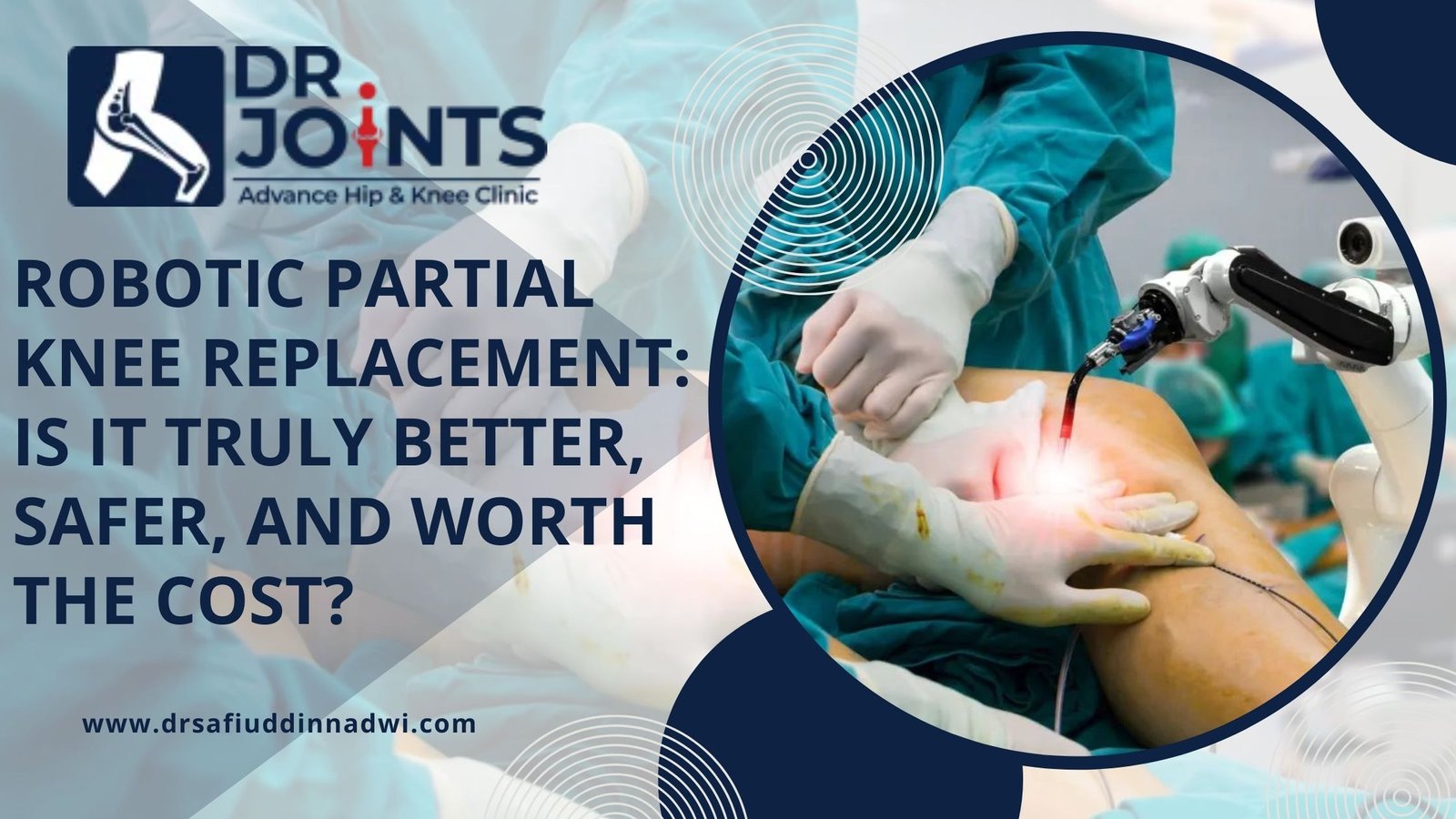
Robotic Partial Knee Replacement: Is It Truly Better, Safer, and Worth the Cost?
Knee pain rarely starts strong. It builds slowly. At first, you feel discomfort after long walks. Then stairs begin to hurt. Sitting down and standing up take effort. Over time, pain controls your routine. You plan your day around what your knee allows.
Most patients try medicines, exercise, or injections. These options help for some time. When pain keeps coming back and movement keeps reducing, surgery becomes the real solution.
Doctors now offer robotic partial knee replacement to selected patients. People hear it gives better accuracy and faster recovery. They also hear it costs more. This creates doubt.
So the real question is simple. Does robotic partial knee replacement actually give better results and long-term value?
What happens inside an arthritic knee
Your knee joint has smooth cartilage covering the bone ends. This cartilage allows easy and pain-free movement. Arthritis slowly wears this surface down. As cartilage thins, bones begin to rub against each other. This causes pain, swelling, stiffness, and loss of movement.
In many patients, arthritis affects only one side of the knee. This happens because daily stress, posture, and body weight often overload one area more than others. The rest of the knee may remain healthy for years.
Why partial knee replacement exists
The knee has three main parts: the inner side, the outer side, and the area behind the kneecap. When damage stays limited to one part, replacing the entire knee removes healthy bone and tissue that still work well.
Partial knee replacement treats only the damaged section. The surgeon removes worn bone and cartilage from that area and places a small implant. Healthy bone, muscles, and ligaments stay intact.
This matters because ligaments guide natural knee movement. Keeping them helps the knee feel stable and normal after surgery. Patients often walk sooner and regain confidence faster.
Limits of traditional partial knee surgery
Traditional partial knee surgery relies on manual tools and visual judgment. Even skilled surgeons face limits. Every knee has a unique shape. Visibility inside the joint stays limited. Hand control always has small variation.
Minor alignment errors may not cause immediate problems. Over time, they can lead to pain, uneven wear, or early implant failure.
What robotic partial knee replacement changes
Robotic partial knee replacement improves how surgeons plan and perform surgery. The surgeon stays in full control. The system supports precision and consistency.
It improves three key areas: planning before surgery, controlled bone preparation during surgery, and confirmation of alignment before finishing.
Planning before robotic knee replacement surgery
Before surgery, doctors scan your knee. These scans create a detailed digital model. This model shows bone shape, joint angles, and movement.
Using this data, the surgeon plans exactly how much bone to remove, where the implant should sit, and how the knee should balance after surgery. This planning removes guesswork and reduces surprises in the operating room.
What happens during robotic surgery
During surgery, the surgeon exposes the knee through a small incision. The robotic system guides bone preparation. It allows movement only within the planned area. Healthy bone and soft tissue stay protected.
If alignment needs adjustment, the system updates instantly. The surgeon does not rely on estimation. The system confirms accuracy in real time.
Why precision affects long-term results
Every step you take places force on your knee implant. Poor alignment shifts this force unevenly. Over time, this can cause pain, stiffness, implant loosening, or early failure.
Robotic guidance improves alignment accuracy. Better alignment means smoother movement, better comfort, and longer implant life.
Robotic knee surgery benefits explained clearly
Robotic planning helps the implant fit your knee shape and movement. This improves comfort. Surgeons remove only damaged bone, which protects strength. Reduced tissue injury leads to less swelling and pain. Patients usually walk sooner and feel stable earlier. Preserved ligaments allow natural knee motion. Accurate placement lowers the risk of early implant wear.
Is robotic knee replacement surgery safer?
Yes, when performed by an experienced surgeon. Smaller incisions reduce infection risk. Less bleeding lowers complications. Controlled bone cuts protect nearby tissue. Real-time feedback improves safety throughout the procedure.
Understanding risks honestly
All surgeries carry risk. Possible issues include infection, blood clots, stiffness, or implant loosening over time. Robotic surgery reduces some risks but does not remove them. Surgeon experience and patient health remain critical.
Robotic partial knee replacement vs traditional surgery
Traditional surgery depends heavily on manual judgment, which can vary. Robotic surgery follows a planned approach, guides execution, and confirms balance before closing. This leads to more consistent outcomes.
Who benefits most from robotic partial knee replacement
Patients often do well when pain stays on one side of the knee, ligaments remain strong, alignment stays reasonable, and activity levels remain moderate to high. Doctors confirm this through scans and physical exams.
Who may need a different option
This surgery may not suit patients with arthritis in all knee compartments, severe knee bending or bowing, weak ligaments, or certain joint diseases. In such cases, total knee replacement may work better.
Recovery timeline explained
Most patients stand and walk within the first day. Pain stays controlled. Over the next two weeks, swelling reduces and movement improves. By weeks three to six, strength returns and daily tasks feel easier. After six weeks, many patients resume normal routines with guidance.
Why rehabilitation matters
Surgery repairs the joint surface. Rehabilitation restores strength and balance. Therapy improves bending, prevents stiffness, supports the implant, and speeds recovery. Skipping rehab delays results.
Understanding the cost difference
Robotic partial knee replacement costs more due to advanced planning systems, specialized equipment, and trained surgical teams.
Is the extra cost worth it?
Many patients feel it is. Faster recovery, less long-term pain treatment, better comfort, and lower chance of repeat surgery add value over time. Worth depends on age, lifestyle, and expectations.
Final Take: Is Robotic Partial Knee Replacement Worth It?
Robotic partial knee replacement is not for everyone. It works best for the right patient, with the right surgeon, at the right center. When these factors align, it offers accurate surgery, safer recovery, natural movement, and lasting comfort.
If knee pain limits your life and damage affects only one part of your knee, robotic knee replacement surgery deserves serious consideration.